
Diagnosing and Repairing Airflow Issues in Your Fridge Compartment
Few appliance problems are as confusing as this: your freezer is running perfectly—ice is solid, meat is rock hard—but the refrigerator section is warm, causing food to spoil. This means your refrigerator isn’t fundamentally broken; it’s simply struggling to move cold air from the freezer (where it’s generated) down to the fridge compartment.
This guide will help you troubleshoot the three main components responsible for controlling that crucial airflow: the vents, the evaporator fan, and the damper control.
Step 1: Check for Airflow Blockage (The Easiest Fix)
The refrigerator compartment relies on cold air flowing out of the freezer and being circulated by a fan. If this path is blocked, the fridge gets warm.

Action: Inspect the Vents and Freezer Coils
- Locate Vents: Inside your refrigerator section (usually on the back wall near the top), look for the small air vents where cold air is blown in from the freezer.
- Move Items: Ensure absolutely no food items (like tall milk jugs, large containers, or pizza boxes) are pushed up against these air vents, blocking the incoming cold air.
- Clear the Return Air Grille: On some models, the return air path (where warm air goes back to the freezer) is often blocked by debris or food packaging.
- Empty the Freezer: If the freezer is severely overloaded, the evaporator fan may not be able to circulate air efficiently across the cold coils, limiting the air supply to the fridge.
Tip: If you recently stocked the freezer heavily or accidentally pushed a bag of frozen vegetables up against the back freezer panel, you may have just solved your problem! Wait 24 hours for the temperature to stabilize.
Step 2: Test the Evaporator Fan Motor (The Noise Test)
The evaporator fan is located inside the freezer compartment, behind the rear panel. Its job is to draw air over the cold evaporator coils and then push a portion of that cold air into the refrigerator section. If this fan fails, the fridge compartment quickly warms up.

Symptoms of a Failed Evaporator Fan:
- The freezer is cold, but the fridge is warm.
- The unit is completely silent (you usually hear a slight hum when the compressor runs).
- The fan makes a loud buzzing or grinding noise (meaning it’s hitting ice or debris).
The Fix (Requires Accessing the Freezer Back Panel):
- Unplug: Unplug the refrigerator before starting any inspection.
- Access the Fan: Empty the freezer and remove the rear panel (usually plastic or cardboard, held by screws) to expose the fan and coils.
- Manual Check: Gently try to spin the fan blades by hand.
- If the blades won’t turn: Ice buildup is preventing rotation. Use a hairdryer on a low, controlled setting to melt the ice around the blades and motor.
- If the blades spin freely: Plug the unit back in (temporarily) and quickly check if the fan motor starts running when the compressor kicks on. If it doesn’t spin, the motor is faulty and needs to be replaced.
Step 3: Inspect the Air Damper Control
The damper control (or diffuser) is the mechanical or electronic gate that physically opens and closes the air vent between the freezer and the fridge. It acts like a throttle, ensuring the fridge doesn’t get too cold.
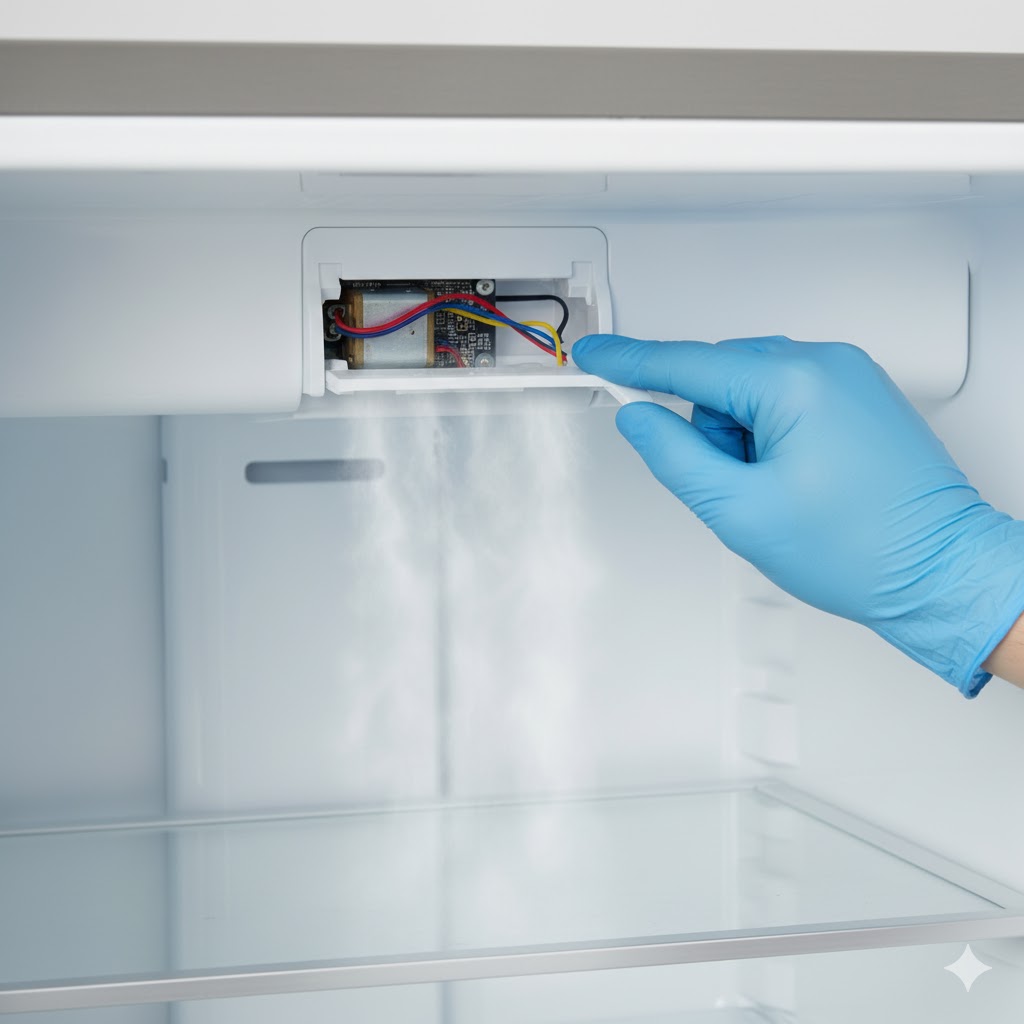
If the damper is stuck closed (due to ice, debris, or a mechanical failure), the fridge compartment will receive no cold air.
Location and Access:
The damper is typically located where the air vent enters the refrigerator compartment (often behind a plastic housing near the top back wall).
- Manual Check: If your refrigerator has a sliding manual cold control inside the fridge section, try cycling it from the minimum setting to the maximum setting. Listen for a light mechanical click or movement as the internal gate opens and closes.
- Visual Inspection: If you can safely access the damper housing:
- Look for ice or debris jamming the small foam or plastic flap that acts as the gate.
- On electronic models, the damper has a small electric motor. If the unit is receiving power but the damper won’t move when commanded, the damper motor is likely faulty and must be replaced.
Because accessing and replacing the electronic damper motor can be complex, this is often the point where calling a professional technician is advisable.
Preventative Maintenance Tips
- Mind the Vents: Make it a permanent rule: Never push food items directly against the back or side walls of the refrigerator, especially near the top vents.
- Check for Frost: If you hear the evaporator fan making a clicking or grinding noise, it often means a thick layer of frost has built up, which can eventually block the vents entirely. You may need to perform a manual full defrost by unplugging the unit and leaving the doors open for 24 hours.
Experiencing persistent cooling issues in the Orange County area?
If you’ve checked the vents and defrosted the evaporator fan without success, the problem likely requires specialized knowledge to replace the damper or motor. Our certified technicians are ready to provide fast, reliable appliance repair in Anaheim and surrounding cities.